
Stay Updated with Our Latest Blogs
Subscribe to our blog and get the latest insurance tips, guides, and industry updates delivered to your inbox
Subscribe to our blog and get the latest insurance tips, guides, and industry updates delivered to your inbox
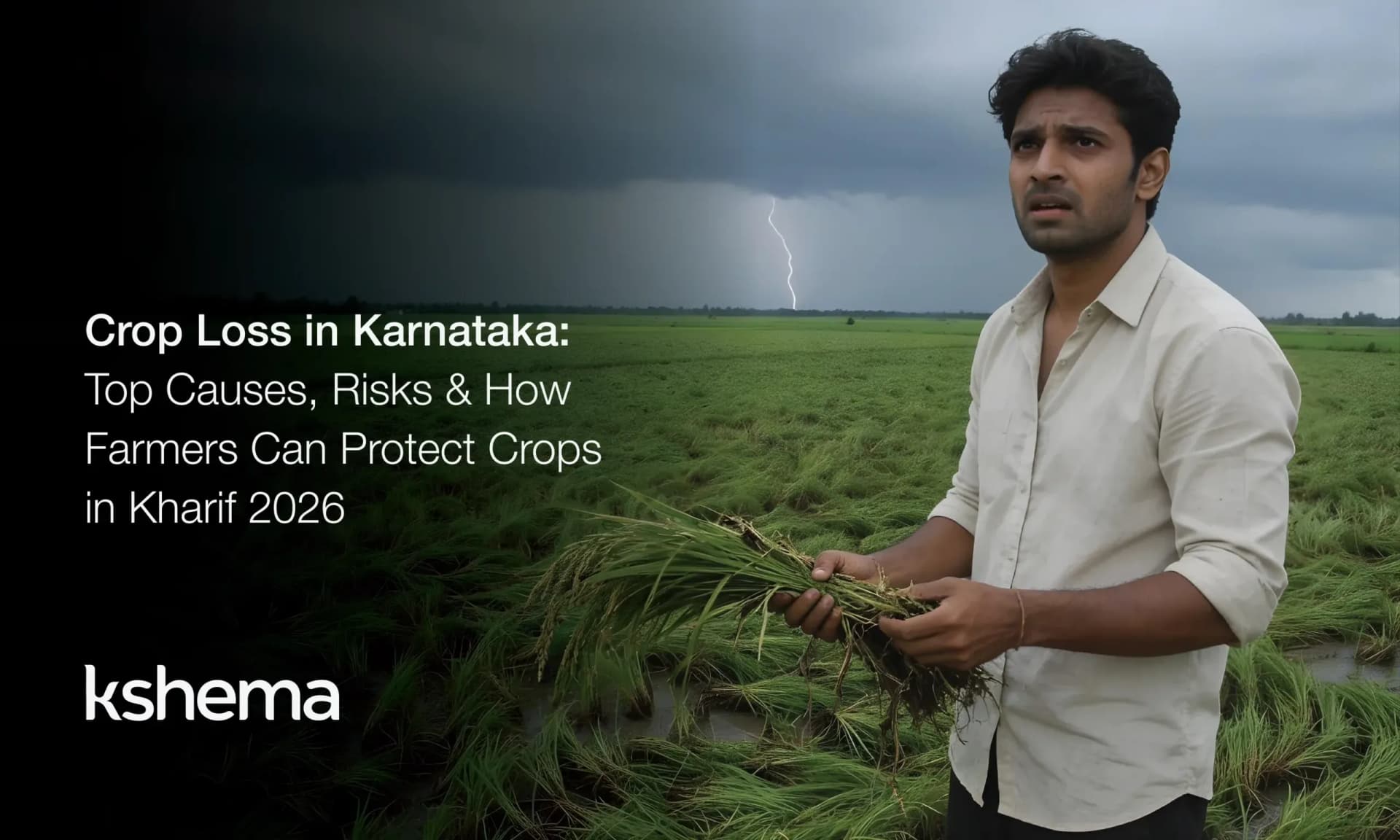
Crop Loss in Karnataka remains a critical challenge for farmers, especially during the kharif season when weather uncertainties are at their peak. Understanding the causes and taking preventive measures can significantly reduce risks and improve yields by understanding proven ways to protect crops.
Crop loss in Karnataka is influenced by a complex mix of climatic, environmental, and human factors. Agriculture in the state heavily depends on monsoon rains, making it vulnerable to irregular rainfall patterns. In recent years, unpredictable weather conditions have intensified the frequency of crop failures, directly affecting farmer incomes and food security and increasing the need for crop insurance protects farmers income.
Additionally, soil health degradation, growing pest resistance, and increased input costs further contribute to crop loss in Karnataka. Small and marginal farmers are particularly impacted, as they often lack adequate financial protection or access to advanced technologies.
One of the biggest drivers of crop loss in Karnataka is the inconsistency of monsoon rains. Delayed onset, prolonged dry spells, or excessive rainfall can severely damage crops such as paddy, maize, and pulses making based on forecasts from the https://mausam.imd.gov.in/.
It important to followhandling monsoon challenges during Kharif season. Flooding in low-lying areas and drought in rain-shadow regions create dual challenges.
Continuous monocropping, excessive fertiliser use, and erosion have degraded soil quality and highlights the importance of soil health and how to maintain it. This leads to lower crop resilience and contributes significantly to crop loss in Karnataka.
Despite improvements, many areas still depend solely on rainfall. Lack of irrigation infrastructure increases exposure to Karnataka kharif crop risks like uneven crop growth.
Though often overlooked, financial losses due to price crashes, poor storage, or transportation issues also add to crop loss in Karnataka just like other parts of the country. Farmers may suffer even after a good harvest if they cannot secure fair prices.
One of the biggest drivers of crop loss in Karnataka is the inconsistency of monsoon rains. Delayed onset, prolonged dry spells, or excessive rainfall can severely damage crops such as paddy, maize, and pulses making based on forecasts from the https://mausam.imd.gov.in/.
It important to followhandling monsoon challenges during Kharif season. Flooding in low-lying areas and drought in rain-shadow regions create dual challenges.
Continuous monocropping, excessive fertiliser use, and erosion have degraded soil quality and highlights the importance of soil health and how to maintain it. This leads to lower crop resilience and contributes significantly to crop loss in Karnataka.
Despite improvements, many areas still depend solely on rainfall. Lack of irrigation infrastructure increases exposure to Karnataka kharif crop risks like uneven crop growth.
Though often overlooked, financial losses due to price crashes, poor storage, or transportation issues also add to crop loss in Karnataka just like other parts of the country. Farmers may suffer even after a good harvest if they cannot secure fair prices.
Farmers must prepare specifically for Karnataka kharif crop risks expected in 2026. Climate experts suggest continued variability in rainfall patterns, which may impact sowing cycles and emphasise the need for weather forecast in farming.
Water scarcity in semi-arid regions could also intensify Karnataka kharif crop risks, particularly for water-intensive crops like sugarcane and paddy. Additionally, rising input costs may limit farmers' ability to adopt preventive measures.
Understanding these risks in advance is essential to avoid significant crop loss in Karnataka and ensure stable farm productivity.
Farmers should consider climate-resilient seed varieties. These crops are better suited to handle unpredictable weather and can reduce crop loss in Karnataka significantly.
Using biological controls, crop rotation, and timely pesticide application can help manage pest outbreaks. This strategy minimises reliance on chemicals and addresses Karnataka kharif crop risks sustainably.
Drip irrigation, sprinkler systems, and rainwater harvesting can enhance water efficiency. Improved irrigation reduces vulnerability to rainfall fluctuations and helps prevent crop loss in Karnataka.
Regular soil testing and balanced fertilisation can restore soil productivity. Organic farming practices and green manuring also improve long-term resilience against crop stress.
Opting for crop insurance schemes such as PMFBY crop insurance India 2026. is a practical way to mitigate financial losses. While it does not prevent damage, it provides a safety net against severe crop loss in Karnataka just like other parts of the country.
Farmers should consider climate-resilient seed varieties. These crops are better suited to handle unpredictable weather and can reduce crop loss in Karnataka significantly.
Using biological controls, crop rotation, and timely pesticide application can help manage pest outbreaks. This strategy minimises reliance on chemicals and addresses Karnataka kharif crop risks sustainably.
Drip irrigation, sprinkler systems, and rainwater harvesting can enhance water efficiency. Improved irrigation reduces vulnerability to rainfall fluctuations and helps prevent crop loss in Karnataka.
Regular soil testing and balanced fertilisation can restore soil productivity. Organic farming practices and green manuring also improve long-term resilience against crop stress.
Opting for crop insurance schemes such as PMFBY crop insurance India 2026. is a practical way to mitigate financial losses. While it does not prevent damage, it provides a safety net against severe crop loss in Karnataka just like other parts of the country.
Modern technologies are playing an increasing role in minimising crop loss in Karnataka. Mobile-based weather alerts, satellite monitoring, and precision farming tools help farmers make informed decisions.
Drones and AI-powered tools are also emerging as effective solutions for detecting pest infestations early. These innovations can directly address Karnataka kharif crop risks by enabling timely intervention.
Furthermore, digital platforms connecting farmers to markets can reduce post-harvest inefficiencies and improve price realisation, thereby lowering overall losses.
Government schemes and community-based initiatives are crucial in tackling crop loss in Karnataka. Programmes that provide subsidies for irrigation equipment, seeds, and fertilisers can ease the financial burden on farmers.
Farmer producer organisations (FPOs) also play a vital role by enabling collective bargaining, sharing resources, and spreading awareness about Karnataka Kharif crop risks. Training programmes focused on sustainable agriculture can further strengthen resilience.
Modern technologies are playing an increasing role in minimising crop loss in Karnataka. Mobile-based weather alerts, satellite monitoring, and precision farming tools help farmers make informed decisions.
Drones and AI-powered tools are also emerging as effective solutions for detecting pest infestations early. These innovations can directly address Karnataka kharif crop risks by enabling timely intervention.
Furthermore, digital platforms connecting farmers to markets can reduce post-harvest inefficiencies and improve price realisation, thereby lowering overall losses.
Government schemes and community-based initiatives are crucial in tackling crop loss in Karnataka. Programmes that provide subsidies for irrigation equipment, seeds, and fertilisers can ease the financial burden on farmers.
Farmer producer organisations (FPOs) also play a vital role by enabling collective bargaining, sharing resources, and spreading awareness about Karnataka Kharif crop risks. Training programmes focused on sustainable agriculture can further strengthen resilience.
Crop loss in Karnataka continues to pose significant challenges, but proactive planning and modern farming techniques can help farmers reduce risks. By understanding Karnataka kharif crop risks and adopting effective preventive measures, farmers can safeguard their livelihoods through how crop insurance can safeguard small farmers livelihoods.
As a next step, farmers should consider combining traditional knowledge with modern tools and enrolling in crop insurance schemes to ensure better protection during the Kharif 2026 season.
The primary reasons include erratic rainfall, poor soil health, and lack of irrigation facilities. Market fluctuations and post-harvest losses also contribute significantly to farmer losses.
Farmers can adopt climate-resilient seeds, improve irrigation, use integrated pest management, and follow proper soil health practices to reduce risks effectively.
Yes, crop insurance provides financial protection against unexpected losses due to natural disasters or other perils helping farmers recover quickly.
Paddy, maize, pulses, and cotton are commonly affected due to dependence on good monsoon.
Technology like weather forecasting, drones, and mobile apps helps farmers monitor crops, detect pests early, and make timely decisions to prevent damage.
The primary reasons include erratic rainfall, poor soil health, and lack of irrigation facilities. Market fluctuations and post-harvest losses also contribute significantly to farmer losses.
Farmers can adopt climate-resilient seeds, improve irrigation, use integrated pest management, and follow proper soil health practices to reduce risks effectively.
Yes, crop insurance provides financial protection against unexpected losses due to natural disasters or other perils helping farmers recover quickly.
Paddy, maize, pulses, and cotton are commonly affected due to dependence on good monsoon.
Technology like weather forecasting, drones, and mobile apps helps farmers monitor crops, detect pests early, and make timely decisions to prevent damage.
“We do not assume any liability for any actions undertaken based on the information provided here. The information gathered from various sources and are displayed here for general guidance and does not constitute any professional advice or warranty of any kind.”
Crop Insurance