
Stay Updated with Our Latest Blogs
Subscribe to our blog and get the latest insurance tips, guides, and industry updates delivered to your inbox
Subscribe to our blog and get the latest insurance tips, guides, and industry updates delivered to your inbox
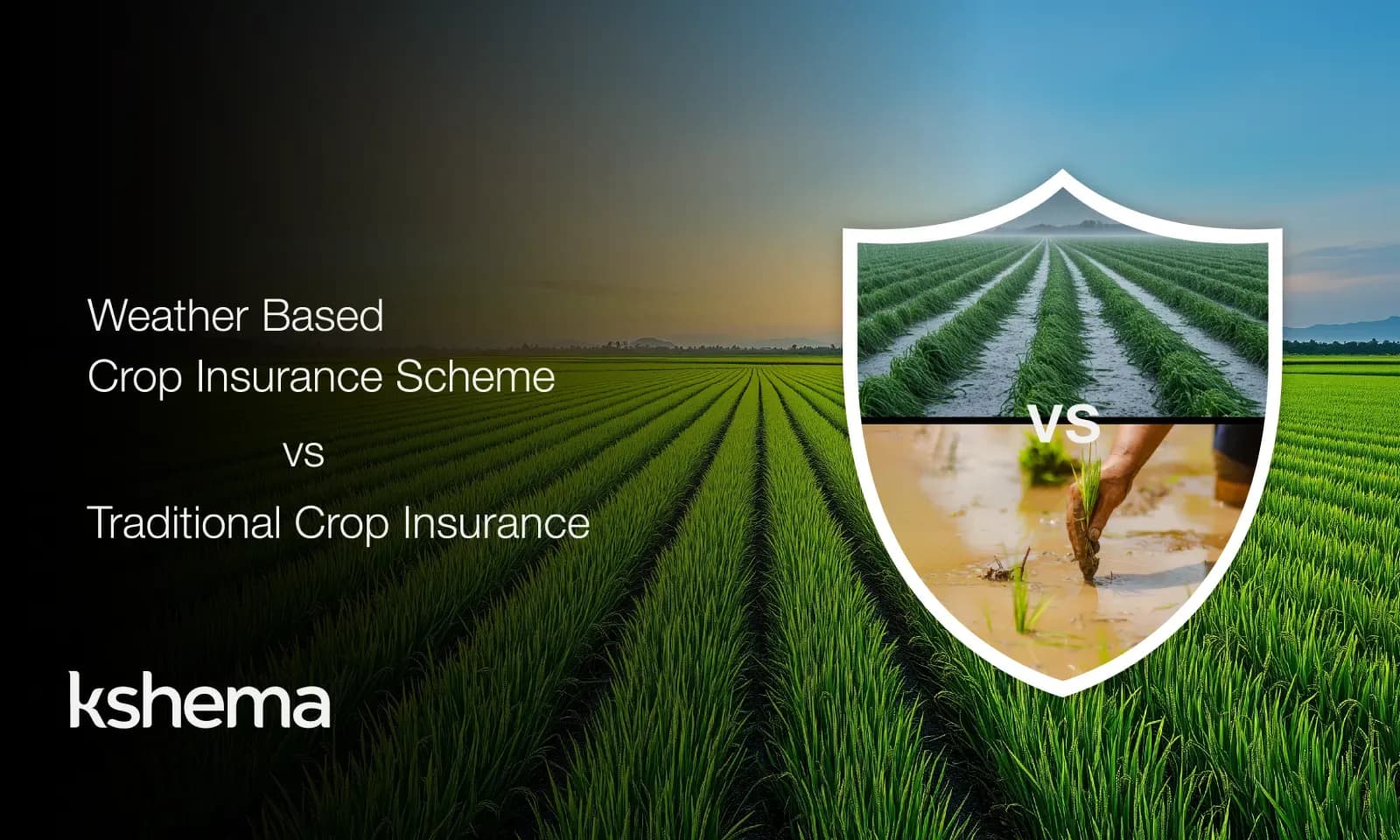
Crop insurance has long been a cornerstone of agricultural risk management, offering farmers protection against the uncertainties of nature. In India and across the globe, two prominent models dominate the landscape: the weather based crop insurance scheme and Traditional crop insurance. While both aim to safeguard farmers’ livelihoods, they differ significantly in design, implementation, and effectiveness.
This blog explores these differences, weighing the advantages and limitations of each, and considering their role in modern agriculture.
Theweather based crop insurance scheme (WBCIS) is a relatively modern innovation. Instead of relying on actual crop yields, it uses weather parameters such as rainfall, temperature, humidity, and wind speed as proxies for crop performance. If these parameters deviate beyond pre-defined thresholds, payouts are automatically triggered.
This approach reduces the need for extensive field surveys and crop-cutting experiments, making the process faster and more transparent. Farmers receive compensation based on weather data rather than waiting for lengthy yield assessments. For deeper policy details, refer to the Official WBCIS guidelines.
Key features include:
Traditional crop insurance has been the backbone of agricultural risk management for decades. It is often referred to as yield based crop insurance, as payouts are determined by actual crop losses measured through crop-cutting experiments and surveys.
This model directly assesses the farmer’s yield against a benchmark or threshold yield. If the farmer’s output falls below the threshold, compensation is provided.
Key features include:
.responsive-table { width: 100%; overflow-x: auto; } table { width: 100%; border-collapse: collapse; min-width: 600px; /* Ensures proper scroll on mobile */ } th, td { border: 1px solid #ccc; padding: 10px; text-align: left; } th { background: #f2f2f2; }
The weather based crop insurance scheme offers several advantages over traditional models:
Traditional crop insurance has been the backbone of agricultural risk management for decades. It is often referred to as yield based crop insurance, as payouts are determined by actual crop losses measured through crop-cutting experiments and surveys.
This model directly assesses the farmer’s yield against a benchmark or threshold yield. If the farmer’s output falls below the threshold, compensation is provided.
Key features include:
.responsive-table { width: 100%; overflow-x: auto; } table { width: 100%; border-collapse: collapse; min-width: 600px; /* Ensures proper scroll on mobile */ } th, td { border: 1px solid #ccc; padding: 10px; text-align: left; } th { background: #f2f2f2; }
The weather based crop insurance scheme offers several advantages over traditional models:
As climate risks worsen, farmers depend even more on crop insurance — learn how it supports them here: crop insurance protects farmers from climate risks
Despite its strengths, the weather based crop insurance scheme is not without challenges:
Traditional crop insurance remains relevant because it directly measures yield. Farmers often perceive it as fairer since payouts reflect actual losses. However, its weaknesses are equally significant:
India’s agricultural landscape is vast and diverse, making a one-size-fits-all approach impractical. The weather based crop insurance scheme has shown promise in addressing systemic inefficiencies, but it must overcome basis risk and infrastructure challenges. Meanwhile, traditional crop insurance continues to provide reassurance to farmers who value direct yield assessments, despite its slower processes.
The way forward may involve:
Despite its strengths, the weather based crop insurance scheme is not without challenges:
Traditional crop insurance remains relevant because it directly measures yield. Farmers often perceive it as fairer since payouts reflect actual losses. However, its weaknesses are equally significant:
India’s agricultural landscape is vast and diverse, making a one-size-fits-all approach impractical. The weather based crop insurance scheme has shown promise in addressing systemic inefficiencies, but it must overcome basis risk and infrastructure challenges. Meanwhile, traditional crop insurance continues to provide reassurance to farmers who value direct yield assessments, despite its slower processes.
The way forward may involve:
Farmers can also compare available insurance options at Kshema crop insurance plans.
The debate between the weather based crop insurance scheme and traditional crop insurance reflects broader questions about efficiency versus accuracy in agricultural risk management. While the former offers speed, transparency, and scalability, the latter provides direct linkage to actual losses but suffers from delays and disputes.
Ultimately, the choice may not be about one versus the other, but about integrating the strengths of both. By leveraging technology, improving infrastructure, and fostering trust, India can build a robust crop insurance ecosystem that truly protects its farmers.
For more details on Kshema as a provider: About Kshema General Insurance
WBCIS provides payouts based on weather conditions like rainfall or temperature instead of yield loss. If weather crosses set limits, farmers receive automatic compensation.
WBCIS uses weather data for payouts, while traditional crop insurance measures actual crop yield loss through field surveys and crop‑cutting experiments.
WBCIS pays faster because it relies on immediate weather data, whereas traditional insurance takes longer due to manual surveys and verification.
Basis risk occurs when farmers face crop loss, but the nearest weather station doesn’t show extreme conditions, resulting in no payout despite real damage.
Both help farmers, but WBCIS suits areas needing quick payouts, while traditional insurance is better where farmers prefer compensation based on actual yield loss.
WBCIS provides payouts based on weather conditions like rainfall or temperature instead of yield loss. If weather crosses set limits, farmers receive automatic compensation.
WBCIS uses weather data for payouts, while traditional crop insurance measures actual crop yield loss through field surveys and crop‑cutting experiments.
WBCIS pays faster because it relies on immediate weather data, whereas traditional insurance takes longer due to manual surveys and verification.
Basis risk occurs when farmers face crop loss, but the nearest weather station doesn’t show extreme conditions, resulting in no payout despite real damage.
Both help farmers, but WBCIS suits areas needing quick payouts, while traditional insurance is better where farmers prefer compensation based on actual yield loss.
We do not assume any liability for any actions undertaken based on the information provided here. The information gathered from various sources and are displayed here for general guidance and does not constitute any professional advice or warranty of any kind.
Crop Insurance